Hay Day
- 4.4
- Rating
- 100.00M
- Installs
- Free
- Price

 Analysis by App-foxy
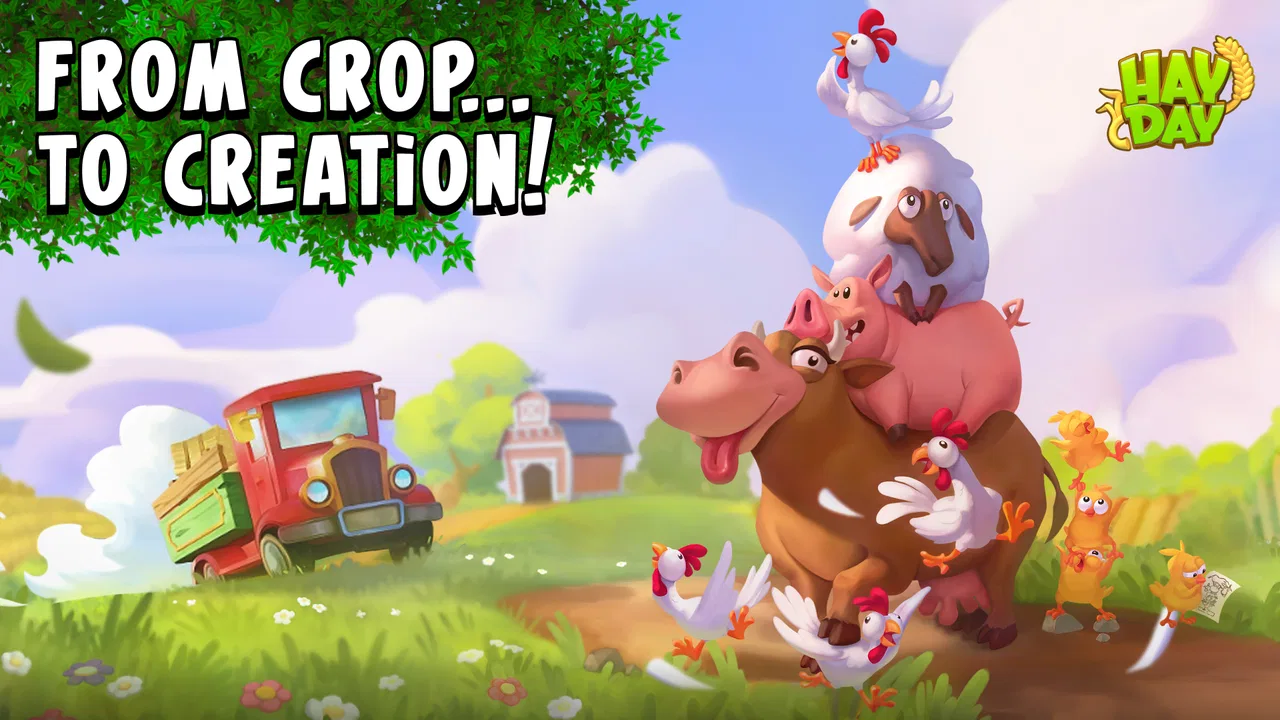
Hay Day is the kind of casual game I can open for a few minutes, make a few useful decisions, and put down without feeling that I have missed an entire event. I grow crops, look after animals, process goods, and gradually turn a small farm into something more organized. That simple loop is the reason it remains easy to recommend to people who enjoy gentle management games rather than fast reflex challenges.
My experience is best described as relaxed, but not completely effortless. The farm keeps asking me to plan ahead: wheat takes time, animals need feed, and useful products often depend on several earlier steps. That creates a pleasant rhythm during a normal day, although it can also become a little demanding when I want one particular item immediately. The game is free to install, and its casual design makes it approachable for a wide audience. It is rated for Everyone, which fits the friendly presentation and uncomplicated controls.
How the farm loop feels after the first few sessions
The opening is easy to understand because the game teaches its main activities through direct interaction. I plant something, harvest it, use it to support another activity, and sell or use the result. The individual actions are simple, but the interesting part is deciding what deserves limited space and attention. A field full of one crop may look productive, yet it can leave me without the ingredients needed for another order.
You May Also Like

 Pandora - Music & Podcasts
Pandora’s Music Is Easy to Start, but Harder to Recover
Pandora’s strength is its low-effort path from a seed to a station. Its weak spot is how much confidence it asks you to place in connection, setup, and quiet recovery.

 8 Ball Pool
 Is Built on Rivalries, Rematches, and Routine
A close look at the rivalries, rematches, shared routines, and unanswered safety questions that turn a quick pool match into a persistent mobile community.

 Samsung Music
’s Quiet Strength Is Playing What You Already Own
Its reach comes less from spectacle than from dependable access to a personal library. That simplicity is both the app’s strongest retention engine and its ceiling.

 AccuWeather: Weather Radar
AccuWeather Review: A Quick, Clear Forecast for Everyday Decisions
For everyday plans, the best forecast is the one you can understand quickly. AccuWeather makes rain timing, radar, and local conditions easy to act on, with a few trade-offs.

 Hill Climb Racing
Why Hill Climb Racing Still Turns Crashes Into One More Run
A tiny car, a bumpy hill and one more upgrade: Hill Climb Racing keeps resurfacing because its simple chaos makes every near-miss feel personal.

 AliExpress - Shopping App
AliExpress Makes Global Shopping Feel Personal, but Shoppers Bear the Risk
AliExpress turns a global marketplace into a pocket-sized discovery engine. Its reach is useful, its shopping loop compelling, and its trade-offs easy to miss.
More From Our News Desk
View All News


That is where Hay Day separates itself from a purely decorative farming toy. I am not only placing buildings and making the farm look attractive. I am also building a small production chain. Animals, crops, and crafted goods depend on one another, so a little preparation saves time later. I found it useful to keep a small reserve of basic materials instead of selling everything as soon as it appeared. That habit prevented many frustrating moments when a request needed something I had just traded away.
The game works especially well in short visits. I can collect finished goods, start the next batch, plant replacement crops, and leave. Later, I return to check what is ready. This makes it a comfortable choice for someone who wants a game that fits around school, work, or household routines. It is less suitable if I want a continuous session with constant action, because much of the satisfaction comes from waiting for a plan to mature.
One practical routine helped me more than simply tapping every available task. I first checked what was already in production, then looked at the next likely need before spending materials. That small pause reduced wasted inputs and made the farm feel more controlled. New players may be tempted to complete every request immediately, but accepting that some orders can wait is part of playing efficiently.
Planning space matters more than it first appears
At the beginning, the farm feels generous because there are not many activities competing for attention. As more possibilities open up, organization becomes important. I learned to think in groups: crops for animal feed, ingredients for processed goods, and items reserved for selling. Keeping everything mentally separate is useful even when the game itself presents the farm as one cheerful place.
Storage pressure is one of the main sources of friction. When space is tight, every decision has a cost. Selling a common item may create room, but it can also remove something needed for a later chain. My advice is to avoid treating the storage area as a place to keep absolutely everything. I regularly cleared items that were easy to replace, while protecting materials that took more steps or longer preparation.
This is also where the game can feel less casual than its bright appearance suggests. The controls are friendly, but good progress rewards patience and memory. If I played without checking my supplies, I often created a bottleneck: one missing ingredient stopped several useful actions. Players who enjoy arranging priorities will probably find that satisfying. Players who prefer spontaneous play may find it surprisingly fiddly.
Decorating the farm adds a personal layer, but I did not see it as the main reason to continue. The strongest motivation for me was improving the flow of production and making the farm less wasteful. A visually attractive layout is enjoyable, yet a practical layout usually saves more frustration. I would place convenience ahead of appearance until the basic routine feels comfortable, then spend time making the space look personal.
Where progress feels rewarding, and where it creates pressure
Progress is gradual rather than dramatic. A better farm comes from many small improvements: more reliable production, better use of materials, and a clearer sense of what to prepare next. That pace suits the casual category, but it also means the game may feel slow to anyone expecting constant unlocks or quick power increases.
The pressure comes from wanting to finish a task before its natural timer or from seeing an attractive opportunity while lacking the required item. I sometimes felt tempted to speed things up simply because the next step was visible. The important distinction is that the game does not need to be rushed to be enjoyable. If I treat waiting as part of the routine, the experience becomes calmer. If I treat every delay as a problem, the same system feels more restrictive.
In-app purchases range from $0.29 to $239.99 per item. That is a wide range, so I would approach spending carefully and decide on a personal limit before making any purchase. The presence of purchases means the free route should be viewed as a patient route, not necessarily the fastest one. I would not recommend buying anything simply because a timer or shortage feels annoying in the moment.
For me, the most sensible way to play without overspending is to use purchases, if at all, as a convenience rather than as a substitute for planning. I would first try changing my production order, keeping better reserves, and accepting fewer urgent requests. Those choices often solve problems that initially look like reasons to spend. This is a useful distinction: a purchase may remove a delay, while better preparation can prevent the delay from mattering.
Playing with other people without turning it into a contest
The social side gives the farm more life than a completely solitary simulator. Working around friends can make ordinary production feel more connected, especially when I want to share progress or compare how differently another player organizes a farm. I enjoy that the social element does not erase the quiet management appeal.
Still, I would not choose this game primarily for intense competition. Its main pleasure is building a routine and improving a personal farm, not mastering a rapid battle system. If I am looking for direct competitive matches, a dedicated multiplayer action game would be a better fit. Hay Day is more comfortable for players who like cooperation, comparison, and gradual development.
On fairness, I would separate social enjoyment from spending pressure. A player who pays may be able to move through waiting periods more quickly, but that does not automatically make the everyday farming decisions more interesting or more skillful. My own satisfaction came from anticipating needs and managing resources. Someone who values equal conditions in a competitive environment may be uncomfortable with any system that allows convenience purchases, even when the core activity remains casual.
I also think the game is best enjoyed when I avoid comparing my farm too closely with someone else’s. Different players may have different amounts of time, different patience levels, and different willingness to spend. Treating another farm as a source of ideas rather than a standard I must match keeps the experience much healthier.
Who will enjoy it, and who should probably skip it
I would recommend Hay Day to players who like gentle progress, simple production chains, and games that can be checked several times during the day. It is a good match for someone who enjoys making small plans, collecting finished work, and seeing a familiar place develop over time. The Everyone age rating also makes its presentation broadly accessible.
I would be more cautious about recommending it to anyone who dislikes timers, inventory decisions, or in-app purchase prompts in free games. It is also not ideal for a player who wants a fully offline-feeling experience with no reason to return later. The farm’s rhythm depends on coming back, checking progress, and deciding what to start next.
Compared with a traditional single-player farming game, this one feels more like an ongoing service-style routine than a self-contained story. A conventional farming title may be better if I want a fixed campaign, a stronger narrative, or uninterrupted control over every minute. Compared with simpler idle games, Hay Day asks more from me because I need to choose what to grow, process, keep, or sell. That extra involvement is its strength and its main source of friction.
A realistic everyday use case is a short morning check before leaving home. I can collect completed goods, plant replacements, begin a longer production task, and leave the farm ready for a later visit. In the evening, I can decide whether to fulfill requests or rebuild supplies. This routine feels more rewarding than opening the game repeatedly without a plan, because each visit has a clear purpose.
Version, accessibility, and what I would check before installing
The current version is 1.69.84, and the listed minimum operating system is Android 7.0. That makes the compatibility requirement relatively approachable for many Android users, although I would still check the device’s available storage and general performance before installing any game that I expect to keep for a long time.
The game comes from Supercell, a developer with a recognizable presence in mobile gaming. It has reached over 100 million installs, with an average rating of 4.3 from around 13 million ratings and about 419 thousand written reviews. Those figures suggest a very large player base, but they should not replace personal judgment: a popular farm game can still be a poor match for someone who dislikes slow progress or purchase-based convenience.
It was released on November 13, 2013, yet the basic appeal remains easy to understand. The long-running nature is useful for players who want a familiar game to return to, though it also means newcomers should not expect to reach the same stage as long-established players immediately. I would begin with modest goals rather than trying to recreate an impressive farm at once.
The price is free, which makes trying it straightforward. I would nevertheless review purchase settings before handing the device to a child, and I would discuss spending expectations with younger players. The Everyone rating describes the content broadly, but it does not remove the need for sensible purchase boundaries on a shared device.
My trust verdict on spending and long-term use
The fairest way to approach Hay Day is to treat time as the main resource and money as an optional convenience. I can enjoy the central farming loop without making a purchase, provided I accept that progress may be slower and that not every request deserves an immediate answer. That is a reasonable arrangement for a casual game, but the broad purchase range means I would not play carelessly with a saved payment method.
I also appreciate that the strongest skills here are not hidden behind speed. Planning crop cycles, protecting scarce materials, and choosing which tasks to ignore can make a bigger difference to my enjoyment than rushing every timer. That gives the free experience a meaningful identity of its own. It is not merely a waiting room before spending; it can be a patient management game if I choose to play it that way.
My reservations are equally clear. The farm can become cluttered with competing demands, storage limits can interrupt a good plan, and the desire to finish something now can make purchases feel more attractive than they need to be. Anyone who is sensitive to that pressure should set boundaries from the start and avoid using money to solve every small inconvenience.
Overall, I see Hay Day as a polished casual farming game for people who enjoy steady routines more than dramatic action. I would recommend it to a friend who likes checking a growing project throughout the day, especially if that friend is comfortable with patience and light resource management. I would point elsewhere for a story-driven farm adventure, a completely uninterrupted offline experience, or a strictly equal competitive game. For the right player, though, its quiet cycle of preparing, producing, and returning later remains genuinely satisfying.
FAQs for Hay Day
01What is Hay Day and how does it work?
Hay Day is a popular farming simulation game where players manage a farm, grow crops, raise animals, and trade goods with neighbors and friends. The game offers a relaxing experience with a vibrant and colorful interface. Players can expand their farm, customize it, and participate in seasonal events to enhance the gameplay.
02Is Hay Day free to play?
Yes, Hay Day is free to download and play. However, it includes in-app purchases for items that can enhance the gaming experience. Players can buy diamonds and other resources to speed up progress, but it's entirely optional. The game can be enjoyed fully without spending real money, as patience and strategy play key roles.
03What devices are compatible with Hay Day?
Hay Day is available on both Android and iOS platforms. It requires Android 4.1 or later and iOS 9.0 or later. The game is optimized for smartphones and tablets, ensuring a smooth experience across different devices. It's recommended to have a stable internet connection for optimal performance and access to all features.
04Can I play Hay Day offline?
No, Hay Day requires an internet connection to play. This ensures that players can interact with friends, trade goods, and participate in global events. The online connectivity also helps in saving progress and synchronizing the game across multiple devices, allowing for a seamless gaming experience.
05How can I recover my Hay Day account if I lose access?
If you lose access to your Hay Day account, you can recover it by linking the game to your Google Play or Game Center account. This way, your progress is saved and can be restored. If you encounter issues, you can contact the support team through the app for assistance with recovering your account.
Pros
- Engaging and relaxing farming gameplay.
- Vibrant graphics with charming animations.
- Cooperative features enhance social play.
- Frequent updates keep the game fresh.
- Offline mode available for limited play.
Cons
- Requires constant internet connectivity.
- Progress can be slow without in-app purchases.
- Limited action for advanced gamers.
- Can be repetitive over time.
- Ads may interrupt gameplay.

Hay Day
Gallery